Cut the list to three items this morning and finished all three by noon, which has never once happened with a list of nine. The nine were never a plan. They were a way of feeling busy about deciding.
The Seedbed — a commonplace book of unfinished ideas
the light comes from the work
The Seedbed
Essays and fragments, borrowed light and things seen — kept together so the small thought may remain beside what it becomes.
The Seedbed in Numbers
- first leaf
- 6 jan 2026
- latest
- 22 jul 2026
- entries
- 55
- issues
- 7
- sheet
- 1 of 2
issue 07
july
2026
11 entriesIn defence of the single stream
For a while I kept two notebooks, and it made me stupid in a very specific way: every time I sat down to write, the first decision was not what to say but where to say it. A short thought felt unworthy of the long book; a long thought got trimmed to fit the short one. The taxonomy was eating the writing before the writing could happen.
So this page is one stream now, and the rule is that there is no rule about length. A single line is an entry. Four paragraphs with a footnote is an entry.1 The kind is a description applied after the fact — a label on the jar, not a decision about which jar to buy. I have never once regretted writing something down; I have frequently regretted the sorting systems I built instead.
The quiet benefit is chronological honesty. When the small things and the large things share a spine, you can see what actually fed what: the line in June that became the argument in July. Sorted into separate ledgers, that lineage is invisible. Kept together, the page reads the way thinking actually goes — unevenly, with seeds and essays next to each other, and no apology for it.
The footnote is how you can tell it takes itself seriously. ↩︎
Nothing new here, and that is the recommendation. Formats that survive are formats that anybody can open with a tool they already have, and plain text has now outlived several generations of better ideas.
The past resembles the future more than one drop of water resembles another.
Rain before work, the kind that makes the street look varnished. I stood at the window longer than the coffee required. Nothing was decided in those minutes, but the day that followed was better for them, and I have stopped asking that kind of time to justify itself.

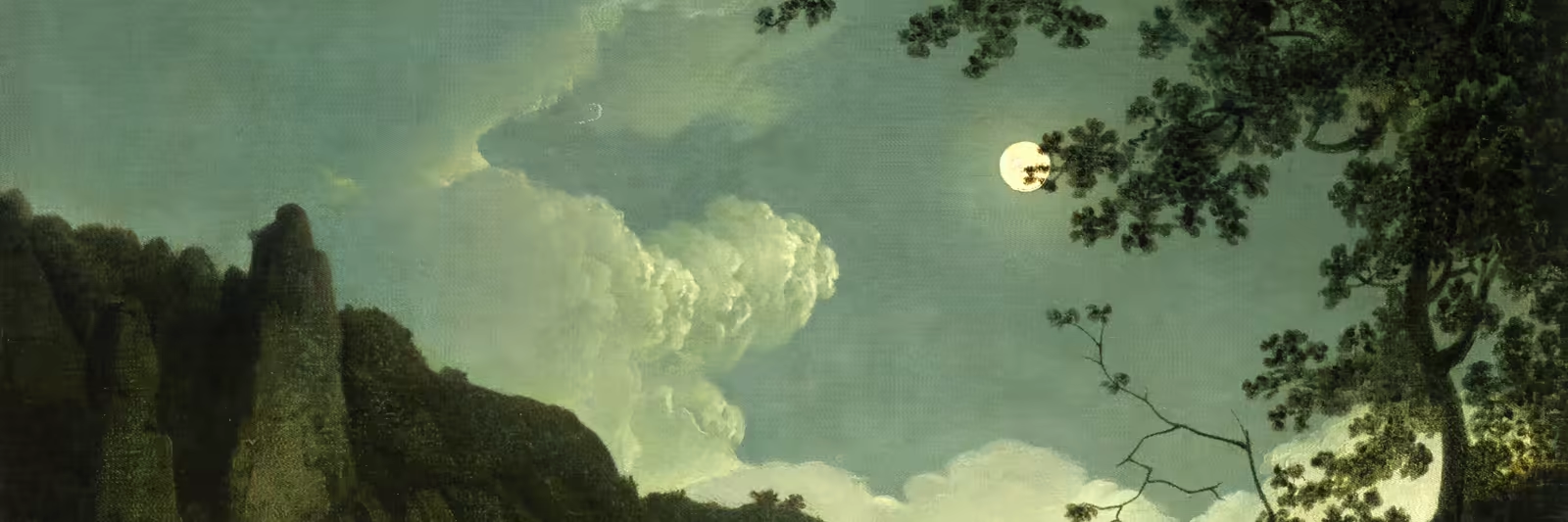
He is not measuring the sky. He is measuring how much of the night he has left to measure it in.
Walked the long way home to finish a thought. It did not finish, but it loosened, which is often the useful part. Speed is good for errands and bad for questions.

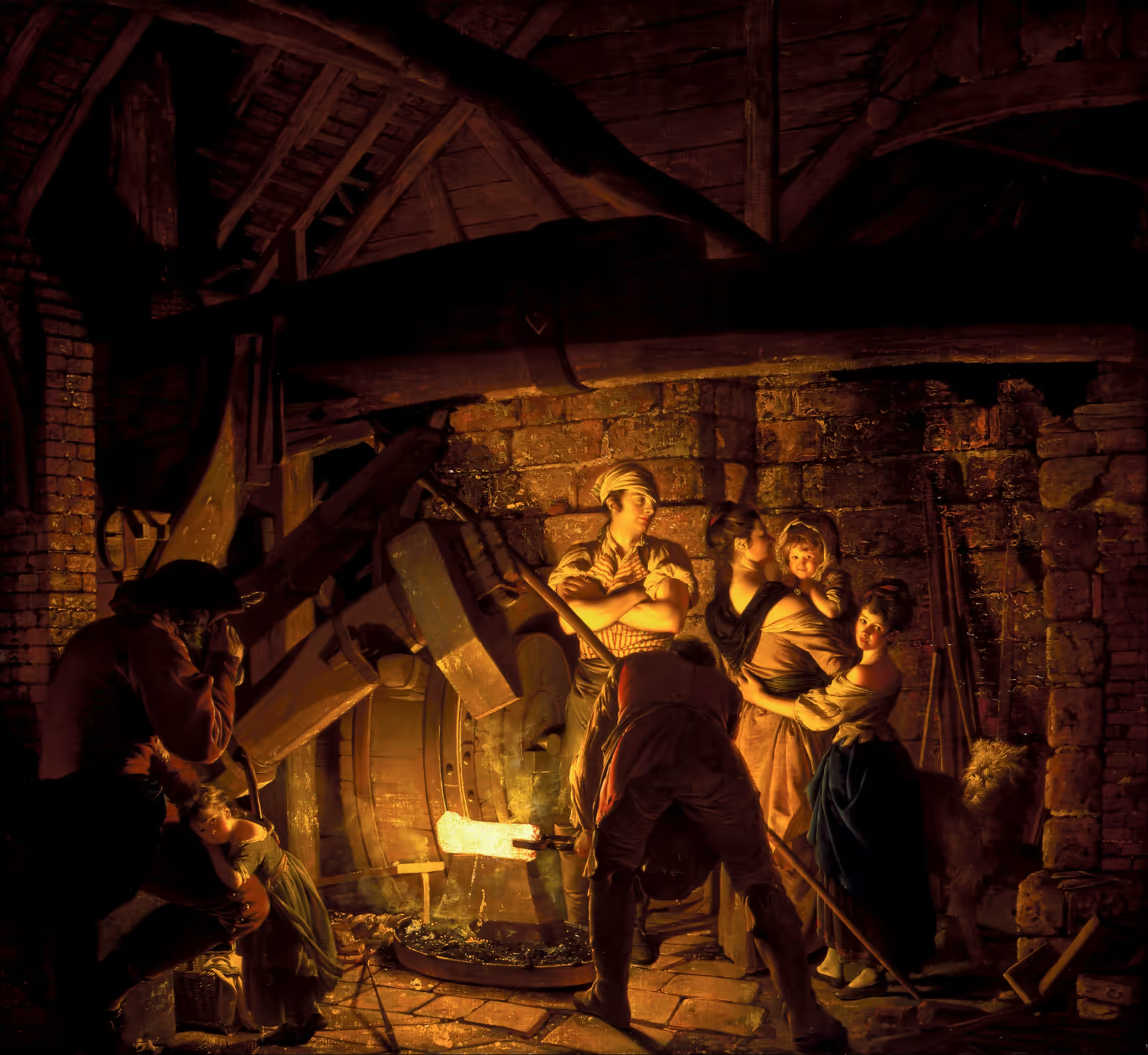
Wright painted industry the way other men painted scripture. Nobody here is posing; the iron is simply the brightest thing in the room, and so everyone looks at it.
Most of what I call planning turns out to be weather.
Borrowed certainty is the heaviest thing to carry, because you cannot put it down without an argument.
The lineage this page hopes to join. Locke kept a formal index for his; I am making do with tags and good intentions.
issue 06
june
2026
9 entriesAgainst the clean slate
Every few months I want to begin again from nothing: new notes, new system, new folder with a confident name. The urge always arrives dressed as clarity, and it is almost always avoidance.
The honest version of the impulse is that the old material has become hard to face. Not disorganised — faced. There are half-finished arguments in there, and opinions I have quietly outgrown, and evidence that I was wrong in writing. A clean slate makes all of that disappear without the work of disagreeing with myself.
What I do instead now is smaller and slower. I keep the old leaves and add a line beneath the ones I no longer believe. The record stops being a monument and becomes a conversation, which is harder to be proud of and much more useful to read.
A slate that is never wiped accumulates something a fresh one cannot: proof that I have changed. That is the only kind of progress I have learned to trust.
A thought written down is a thought you can argue with.
Everything is gestation and then bringing forth.
Useful for the mechanics rather than the romance: how headings were chosen, why the index mattered more than the entries, and how little of it was ever meant to be read straight through.
On the honesty of clocks
Coffee, then the long task of making a homepage feel inhabited rather than just tidy.
We are our memory, we are that chimerical museum of shifting shapes, that pile of broken mirrors.
Privacy is not a wall you build once. It is a practice, like tidiness, and it fails the same way: quietly, by small permissions.
A good question survives its first answer. If the answer closes the subject, I was probably asking about a fact; if the answer opens three more rooms, I was asking about something worth carrying.
issue 05
may
2026
6 entriesAn inbox is a portrait of what other people want. A notebook is a portrait of what you want. Keep the second one longer.
What then is time? If no one asks me, I know; if I wish to explain it to one who asks, I know not.

The same hand that painted the forge painted this. One canvas is all heat and company; the other is all cold and solitude. I keep them together on purpose.
Fourth rewrite of the same small function tonight. The behaviour has not changed once. What changed is that I can now read it without holding my breath, which I have decided counts as progress.
A plain account of how quickly the record dissolves. Worth the road for one idea: the web does not decay evenly, and the parts that vanish first are the parts nobody was paid to keep.
Two kinds of patience: waiting, and continuing. Only one of them is a virtue.
issue 04
april
2026
9 entriesApril, in the ledger: more mornings kept than lost. That is the whole report, and it is enough.
On tools that teach
A good tool does two jobs. It finishes the work in front of you, and it changes what you believe the work is. The first job is the one we shop for. The second is the one that shapes us.
A hand plane teaches grain. A debugger teaches that a program is a sequence of states rather than a paragraph of intentions. Neither lesson appears in the manual, and both survive long after the particular task is forgotten.
So I have grown suspicious of tools that finish the work without teaching anything. They are not evil; they are simply expensive in a currency that does not show up on the invoice. When the tool leaves, the understanding leaves with it, and I am exactly as capable as I was before I began.
The test I apply now is small: after using this thing for a month, will I know something I could explain to another person? If the answer is no, I try to keep the tool at arm’s length, and do at least one pass by hand.
In praise of the unfinished shelf
There is a shelf here of things abandoned: two half-built programs, a translation that stalled at the third page, and a set of notes for an essay I no longer agree with. For years I thought of it as evidence of failure.
I have changed my mind. The shelf is where the ideas go that were not wrong, only early. Twice now something from it has come back and finished itself quickly, because the difficult part had already been done and left to cool.
The condition is that the shelf must stay visible. Abandoned work hidden in an archive is simply lost; abandoned work in plain sight is a standing offer. I walk past it most days, and every so often it accepts.
The hour before the house wakes is the only hour nobody has asked me for. I have stopped calling it productive. It is simply mine, and I spend it slowly on purpose.
Absolutely unmixed attention is prayer.
Attention is the rarest and purest form of generosity.
Spent the evening sharpening rather than cutting. Nothing was produced and tomorrow will be twice as fast, which is a trade I am still learning to make without feeling guilty about it.
Measure twice, cut once — but read the drawing three times before you measure.
Every catalogue is an argument about what matters, pretending to be a list.
issue 03
march
2026
7 entriesThe morning does not owe me clarity. I owe the morning attendance. On the days I remember which direction the debt runs, the work goes considerably better.
Nothing worth keeping has ever been finished on the first attempt, and nothing at all has been finished on the tenth.
Unfashionable and correct. Every layer you add between the text and the reader is a layer that has to survive twenty years of nobody maintaining it.
Borrowed a book and found a stranger’s pencil in the margins, arguing with chapter four. I finished the chapter twice: once for the author, once for whoever had been so patiently annoyed by him.
Nothing is ours except time.
What the notebook knows
The useful thing about a notebook is not that it remembers. It is that it disagrees. Memory is a diplomat; it smooths the record until the past appears to have led sensibly to the present. Paper has no such manners.
I went back this week to entries from four years ago, expecting continuity, and found a person confidently certain of two things I now think are false. There was no gradual revision in between. The change happened somewhere off the page, and I would have sworn under oath that I had always believed the later version.
That is the whole case for keeping a record: not nostalgia, and not productivity, but the ability to be contradicted by primary evidence. It is the cheapest available protection against becoming a person who has never been wrong.
Arguments about tools are forgotten in a year. The files made with them are still here in ten. Optimise for the files.